
Along the surface of a fault, the direction of the slip is related to the stress field, which, in turn, depends on the direction of the forces acting from the mantle on the Earth’s crust. The two sides of a fault are defined as hanging wall and footwall and identify, respectively, the volume of rock above and below the rupture surface. Based on the direction of relative sliding between hanging wall e footwall two main types of fault are identified:
distensive fault or normal, in which forces act with a pull on the blocks; at the moment of rupture, these forces induce a sliding of thehanging wall with respect to the footwall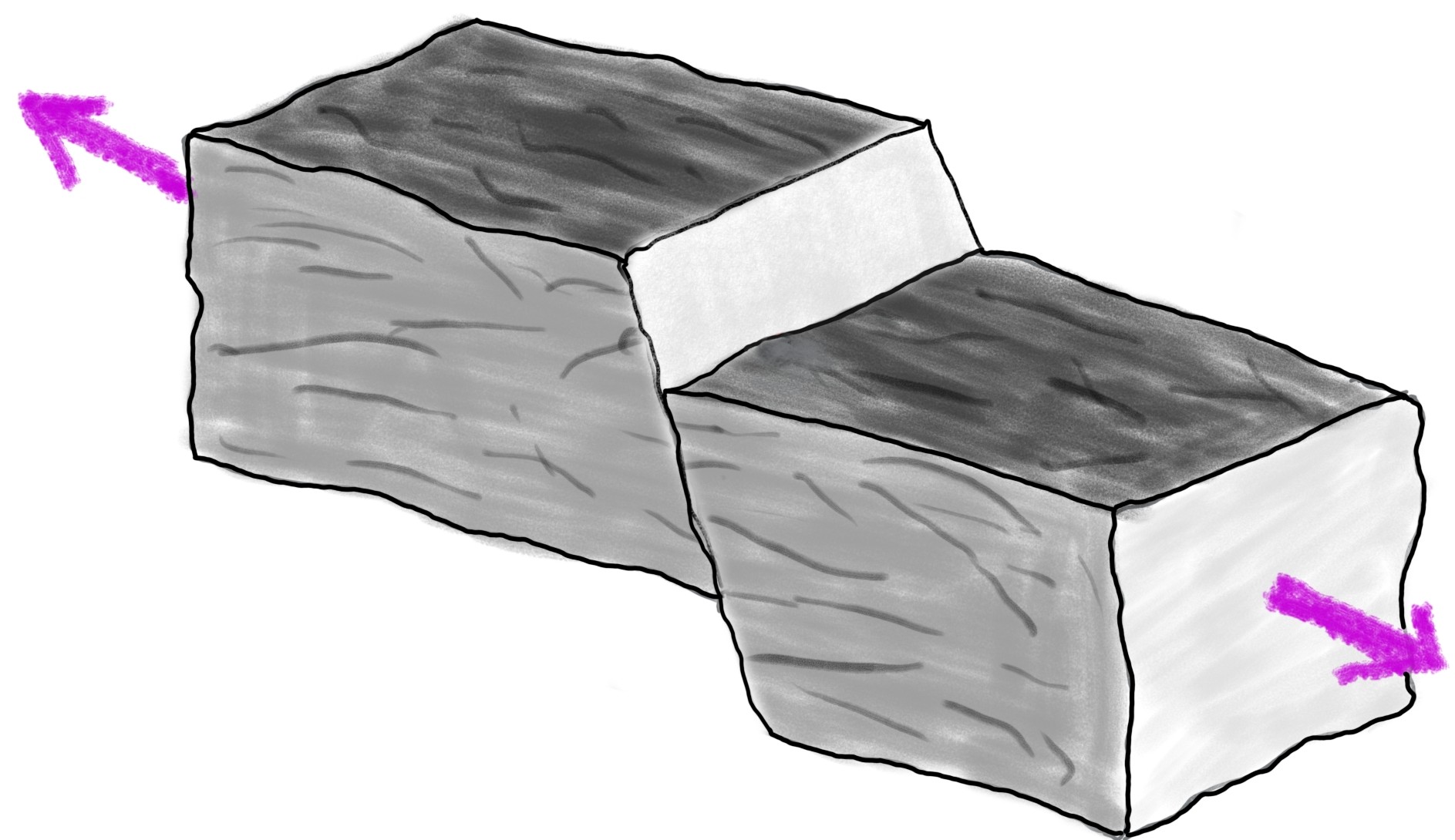 compressional fault or reverse or thrust, in which forces compress the rock blocks until, at the time of rupture, there is overthrusting of the hanging wall above the footwall
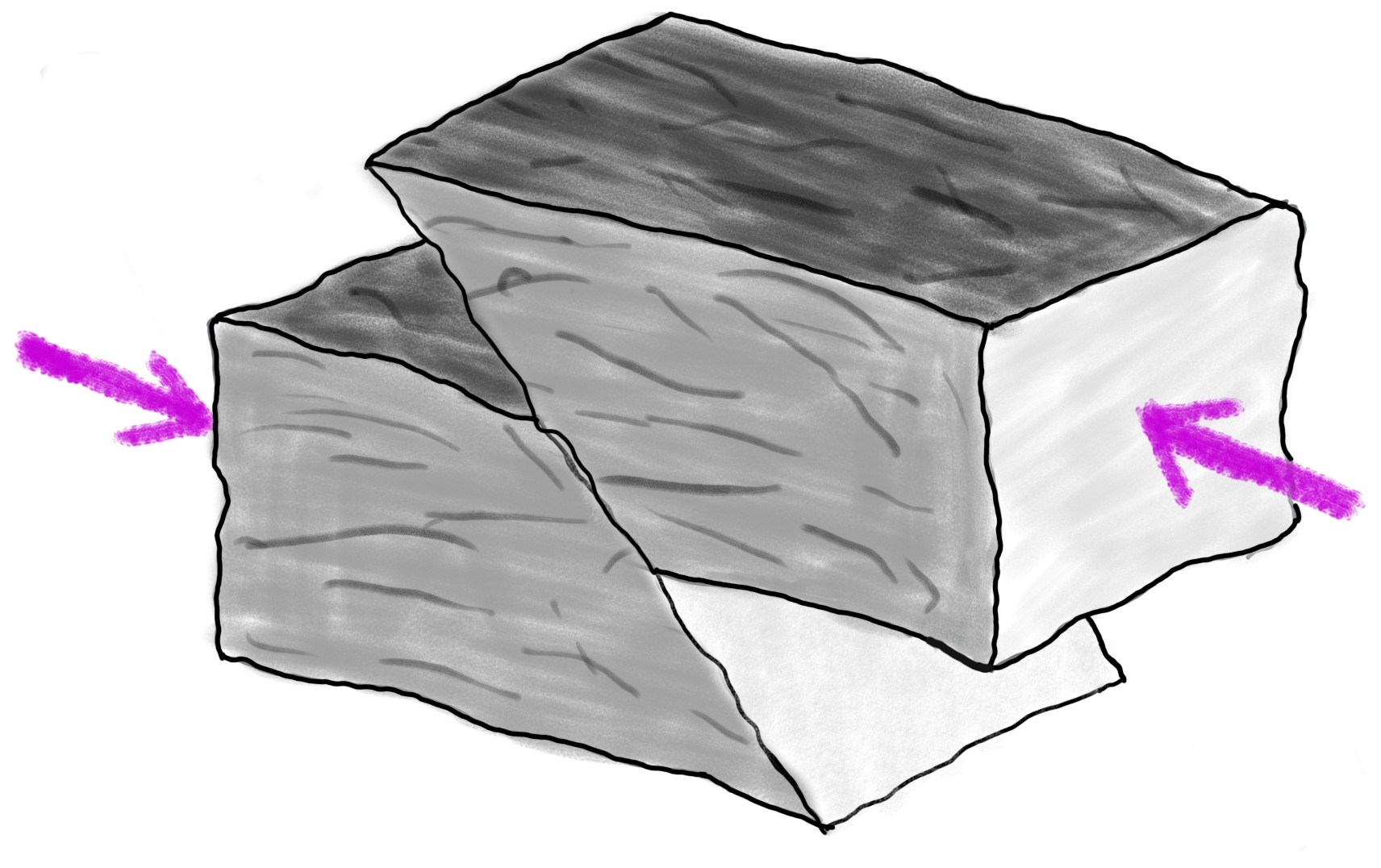 Vertical faults, for which there is no clear distinction between hanging wall and footwall, the slip is in general predominantly horizontal and described as transcurrent faults. Again, we can distinguish a right-lateral transcurrent faults
 and left-lateral transcurrent faults
 In reality, in the earth’s crust, forces can have directions intermediate to the cases illustrated above, therefore the rupture can take any diagonal direction intermediate among those illustrated in the figure. For this reason, in addition to a qualitative description of the rupture mechanism (compressive, transcurrent, etc…) there is a parameter called rake which describes precisely the angle of the direction of the rupture on the fault plane, i.e., the sliding angle of the hanging wall with respect to the footwall.
  Rake e slip, together, thus define the mechanism and amount of mutual slip between the margins of a seismogenic fault.
Two other angles are used to define the slope and orientation of the fault plane and are, respectively, the dip and the strike. The dip describes the angle of the fault plane with respect to an horizontal plane and the strike that between north and the upper edge of the fault. 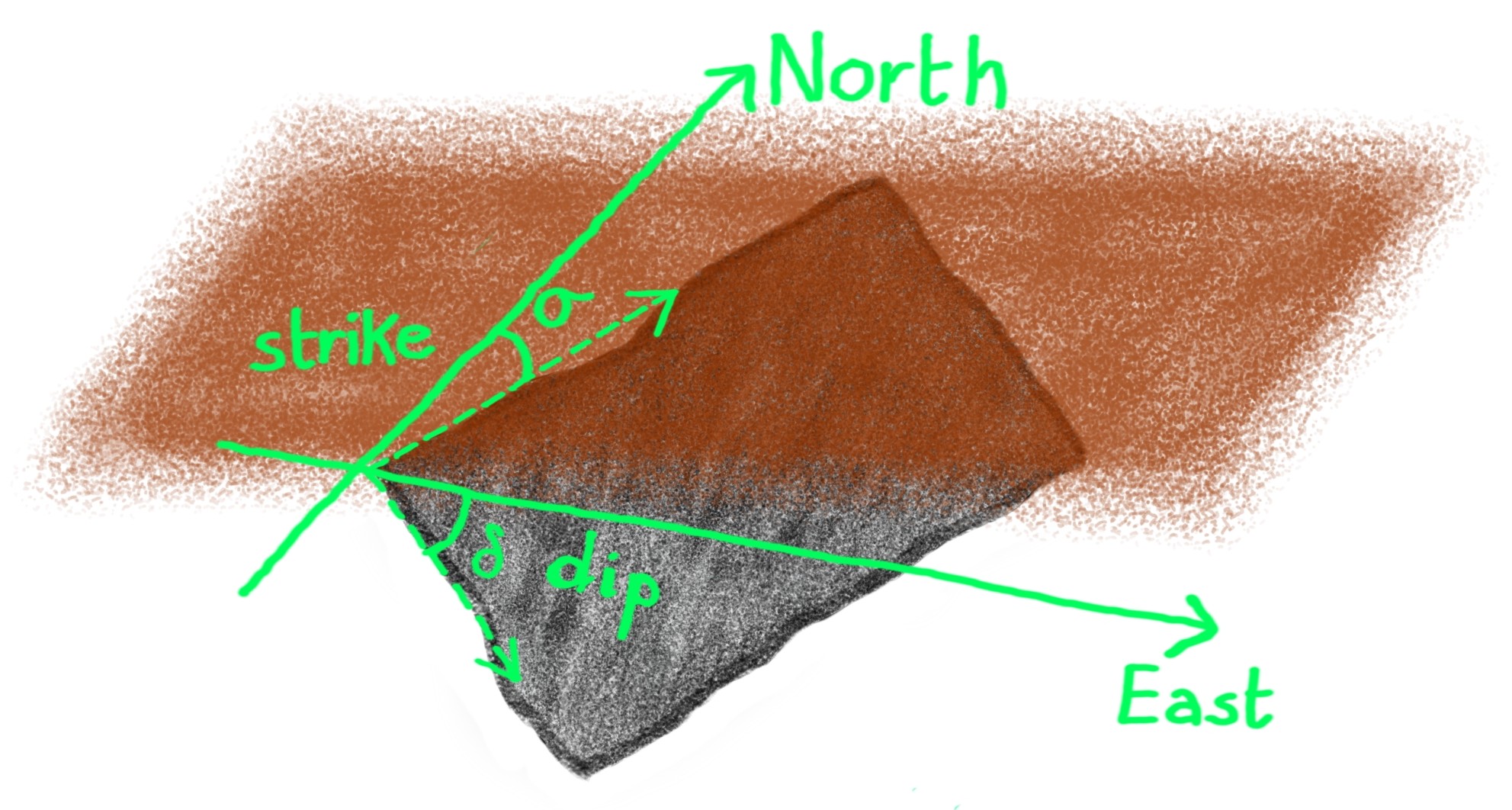 What actually happens during an earthquake is more complex than a simple uniform slip on a flat surface; the fault represents a rupture zone that can have large geometric heterogeneities. For strong earthquakes, the main fault may consist of several segments, and adjacent secondary faults may rupture at the same time. Depending on the complexity of the rupture, all the parameters illustrated above (slip, rake, dip and strike) can vary, even greatly, from one point on the fault to another, or from one segment to another.
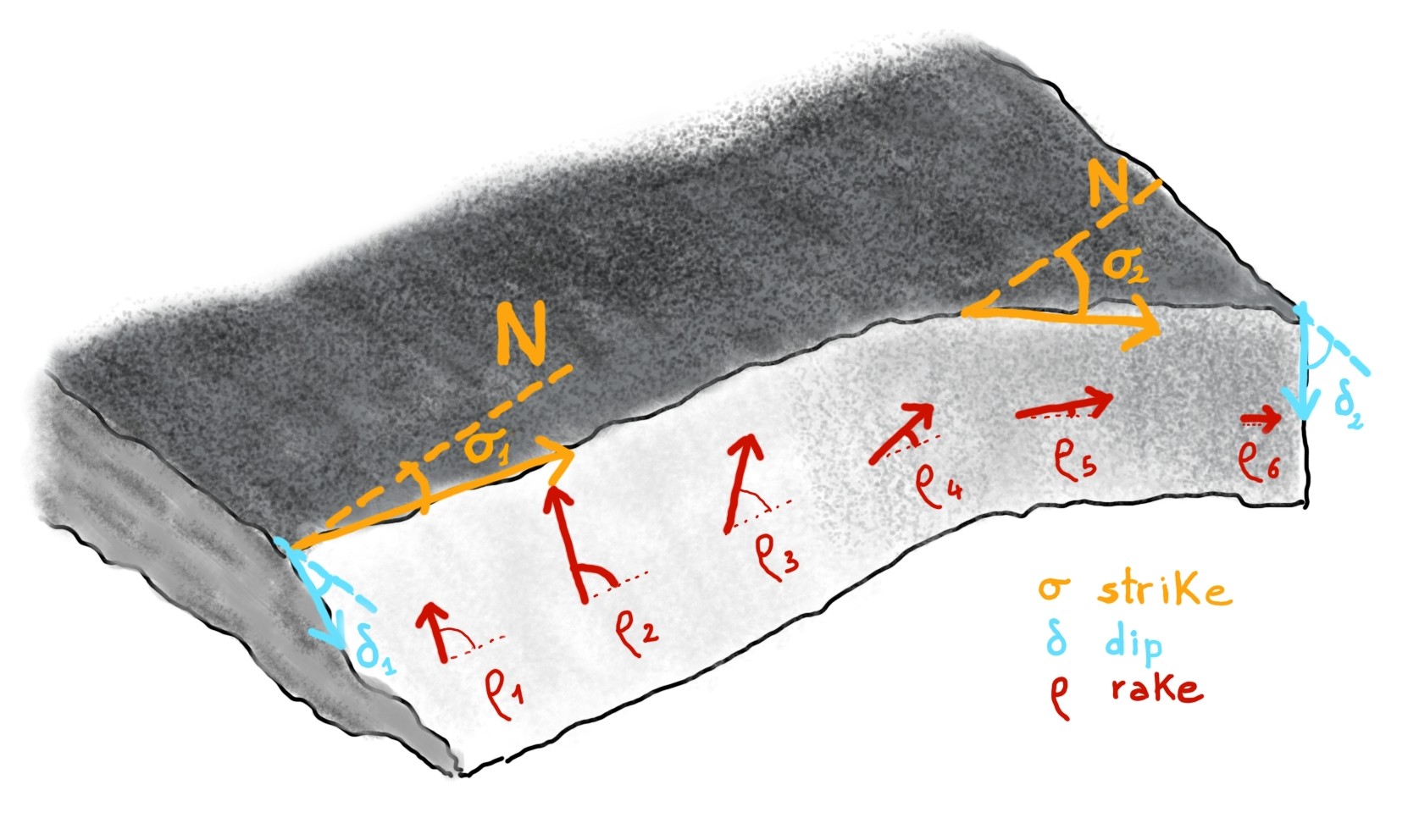 It is not easy to reconstruct the geometric complexity of a fault, nor the way its parameters vary in the volume of rock; except for those portions of the fault that outcrop at the surface, direct observation of the sliding at depth is in fact not possible. We must analyze data recorded at the surface: seismic waveforms recorded by seismographs or permanent deformation measured by satellite or on the ground.

