
A fault rupturing triggers several phenomena, including the generation and propagation of seismic waves and the permanent deformation of the volume of Earth’s crust around it.
Seismic waves are the cause of the shaking felt by people; they can undermine man-made structures and trigger, in turn, secondary phenomena such as landslides or liquefaction of soils.
Permanent induced deformations, on the other hand, constitute a change in the surrounding rock and, as earthquakes recur, are the basis for the modeling of the topography.
Seismic waves and permanent deformations attenuate differently with distance from the fault. Seismic waves, even for an earthquake of moderate magnitude, can be felt by people hundreds of kilometers from the epicenter; seismometers, highly sensitive instruments, can detect their passage even from the opposite side of the planet. Permanent deformations, on the other hand, affect very limited areas, no larger than two or three times the size of the fault itself.
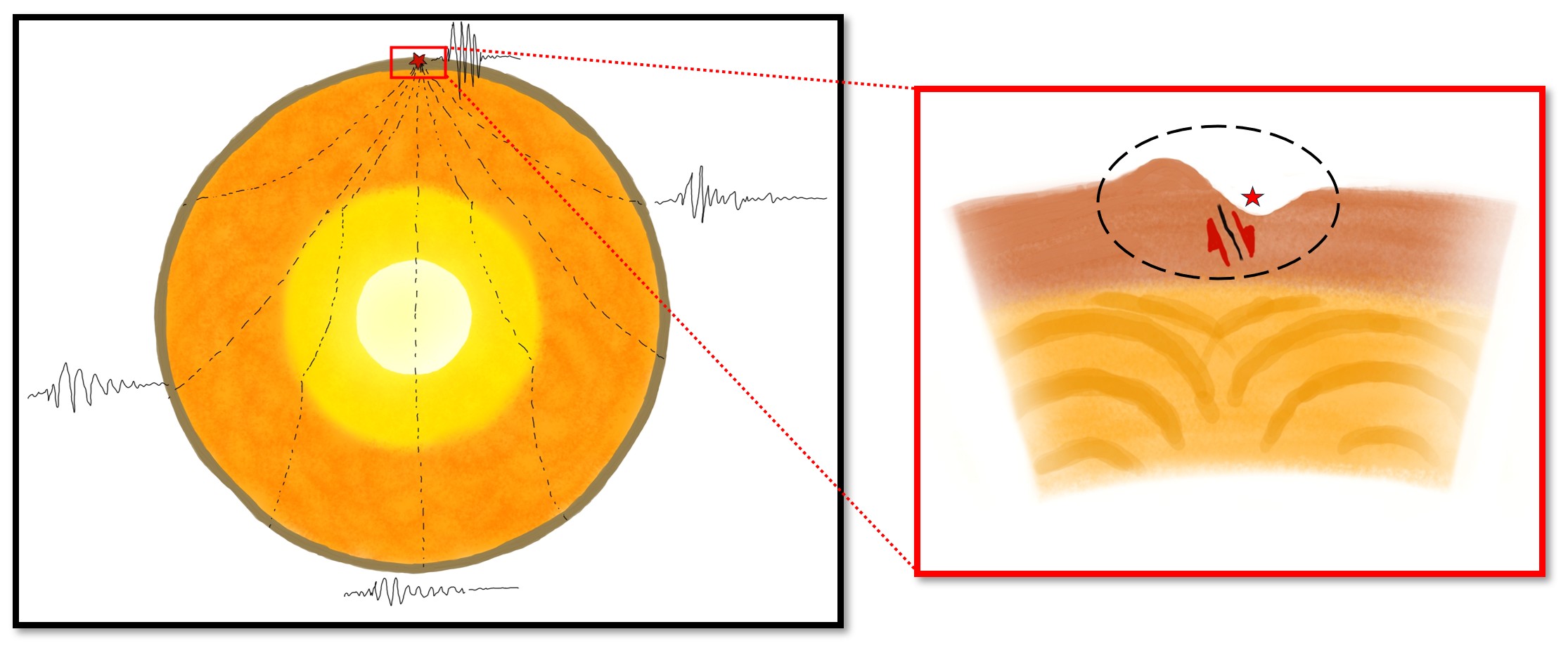
Both seismic waves and permanent deformations are used to derive information about the seismic source. However, while seismic waves are detected by seismometers and thus are observations made on scattered and distant points, there are techniques, based on satellite imagery, that produce a complete map of deformations affecting the epicenter area.
These maps show the near field deformation of an earthquake and this allows a very detailed reconstruction of the fault that generated it. The faults of the Finite Source portal are derived from the analysis of permanent deformations based on satellite imagery.
If you’re interested in learning more about the process to retrieve fault information, you can read this page on earthquakes seen by satellite: you will find that even ground displacements of a few centimeters can be measured by instruments orbiting hundreds of kilometers above sea level!

